Image credit: Pexels
Business leaders are deploying AI agents to automate complex workflows, but experts say governance, human oversight, and strategic planning remain critical to long-term success.
Agentic AI is transforming the way organizations operate, shifting artificial intelligence from a reactive support tool to an autonomous system capable of executing complex, multi-step workflows. As companies look to reduce operational friction, improve productivity, and scale more efficiently, leaders are turning to AI agents. Amid this growing acceptance of technology, experts emphasize that successful adoption depends not only on technology but also on governance, process design, and thoughtful change management.
Critical Thinking Remains Essential in an Automated World
For David Viney, Founder of Alchemy Consulting, the rise of agentic AI places a new responsibility on leaders: maintaining critical thinking in an automated environment. Rather than treating AI outputs as definitive answers, organizations must create cultures that continuously question and validate results.
“The tendency for humans is to just accept the AI output too readily after a period of time—not to question it, not to interrogate it, to accept it as gospel when, as anyone who works in the field will tell you, it absolutely is not going to be gospel. There’s a statistically predictable amount of it that will be total garbage.”
As AI agents begin operating across multiple platforms and business systems, governance becomes even more important. Drawing on his experience building governance infrastructure at WPP Open using IBM’s Watson framework, Viney highlighted the growing risks associated with autonomous systems.
“When you’re setting off agents, they’re going to operate across different systems, they’re going to operate across different boundaries… The potential for model drift, the potential for data narrowing and hallucination becomes much larger. So it becomes super, super important to be able to monitor and hold to account what you’re doing.”
Beyond technical oversight, Viney believes leaders must also address employee concerns about automation and workplace change.
“That was a question that deserved a better answer for me as a leader… because, yes, it was the thin end of a very long wedge. And it really kind of raised my attention early on to the sort of change challenges that you get in this space, you know, the natural fears that people have, needing to meet that moment in a human way, rather than just dismissing it as a technologist.”
Agentic AI to Reduce Friction and Scale Productivity
While governance remains a priority, organizations are also discovering practical ways to use AI agents to streamline operations. At eBay, agentic AI is helping simplify marketplace interactions and improve seller experiences.
According to Ashay Satav, Director of Product Management at eBay, the company’s strategy is rooted in the unique nature of its marketplace.
“Amazon and Walmart are basically dealing with commodity products… On the other hand, eBay has been known for differentiated products—products that you won’t find anywhere. If you are a collector who wants to buy a coin that is 200 years old, you won’t get it on Amazon or Walmart. You can only get it on eBay.”
To address one of the biggest challenges facing sellers, eBay developed its “Magical Listing” feature.
“One of the biggest pain points for sellers was how do I bring up inventory in the least frictional way possible. That’s where we used AI—I built a pipeline where you just provide photos, and by using those photos and our titles, we can fetch all the item aspects and build the listing on your behalf.”
The company is now expanding its efforts through an agentic commerce platform designed to empower teams and developers.
“This is a platform that helps domain teams create their own agents… we have also seen changes in how we think about developer productivity because developers have been able to code, test, and basically push out to production much earlier and much sooner, and much more repeatably compared to what we saw earlier.”
Successful Deployments Depend on Planning and Change Management
For Chad Lohrli, Co-Founder and Chief AI Officer at Cadre AI, understanding how AI agents interact with business systems is key to unlocking their value.
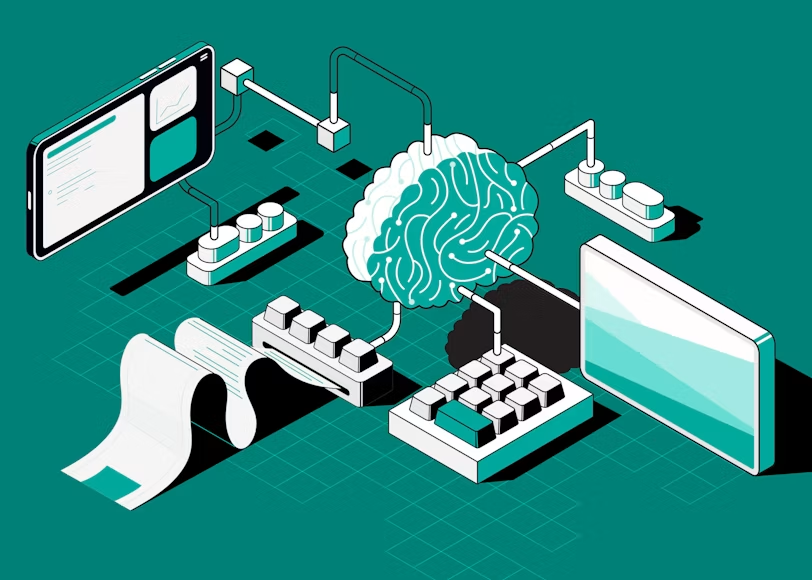
“The LLM is the brain, but the agent is this harness around the brain that’s able to call different tools. Based on those tools, make decisions to call other tools—and that’s how you get a system that’s able to interact with a lot of different business processes, whether that’s CRMs or ERP systems or project management systems, communication protocols like Slack or email.”
However, implementation requires far more than simply deploying technology.
“The planning, the execution, and most important of all, the change management of that process is extremely important to get it right… You can take a horse to water, but you can’t make them swim. You can’t just drop off new technology… the importance of making sure you roll out this technology appropriately, you get buy-in from key stakeholders, you bring in champions early, and you make sure that everyone’s educated and fluent in the new technology.”
Lohrli added that organizations must thoroughly understand existing workflows before introducing agents into them.
“We see businesses as a graph of processes and connections between those processes or departments. And so when you think about putting an agent into that process or augmenting it, you really need to deeply understand the existing process and what humans are doing… It is so important to get data and feedback from our clients, because they understand their business.”
Structure and Oversight Come Before Automation
The emphasis on process design is echoed by Sergey Matikaynen, Co-Founder of GoGloby, who argues that organizations must establish structure before applying AI.
“Our approach is: formalize your existing process, write it down in steps, what you have right now, manually, pretty much a manual process, and then find the right places where AI should be applicable. As soon as you have a formalized process and all the policies in place, it’s really easy to apply AI technologies, including agentic approaches. Because whenever you have chaos in the beginning and nothing is established internally, it becomes a mess.”
Human oversight remains a non-negotiable principle within the company.
“We never give a chance to AI to make final decisions about candidates, about people, first of all. This is our policy, and it is enforced across our organization. So we always need a human sign-off, final sign-off, before we do that. Otherwise, we believe that this won’t be ethical if some algorithm decides without even a human being involved.”
Matikaynen also pointed to the growing importance of monitoring AI-related costs.
“The next thing that should be managed is pricing and how much money companies spend on tokens… You can have a task that will earn you $1,000 in production, but you spend $10,000 to actually pay for the tokens. We work on specific services with performance dashboards and metrics that give a chance to estimate not only story points and human hours, but also tokens for the tasks that you will be using AI for.”
Solving Business Problems First
Thomas Crawshaw, Founder of The AI Architects, believes organizations should focus on business challenges before choosing AI solutions.
“Purposeful AI, in my opinion, is figuring out the problem that you need to solve with it. And then, as a software engineer would do, they would create a plan, create an MVP, V1; there’d be different stages to the development, there’d be testing, there would be feedback, and ultimately you end up with something useful at the end of the day.”
While Crawshaw sees AI as a valuable creative assistant, he distinguishes ideation and final output.
“In the creative process, I think we can leverage AI for brainstorming, for fanning out queries, and just trying to get a little bit more info… I wouldn’t personally be comfortable putting out a song with an AI-generated backing track, for example, but if I went on to Suno, and I put my lyrics in and generated a bunch of different tracks, and a melody’s pretty good—I might take a portion of that melody and merge it into the song or tweak it.”
Looking ahead, Crawshaw believes the conversation around AI governance will only become more urgent.
“I do believe we will get to AGI and superintelligence and the implications of that—nobody really knows… I do see bad things potentially arising from the misuse of AI. I think we are past the point of no return, and that nobody wants to really regulate or safeguard it as they should, because they may fall behind—there’s a lot of money getting poured into it.”
Strategy and Governance Define Success
As agentic AI becomes embedded in enterprise workflows, the value of strategy, governance, and human oversight is increasingly recognized before deployment. From formalizing processes and monitoring outputs to managing costs and maintaining ethical safeguards, organizations that approach AI agents with discipline and clarity are likely to achieve the greatest benefits. Success with agentic AI is proving to be as much about leadership and organizational readiness as it is about technology itself.