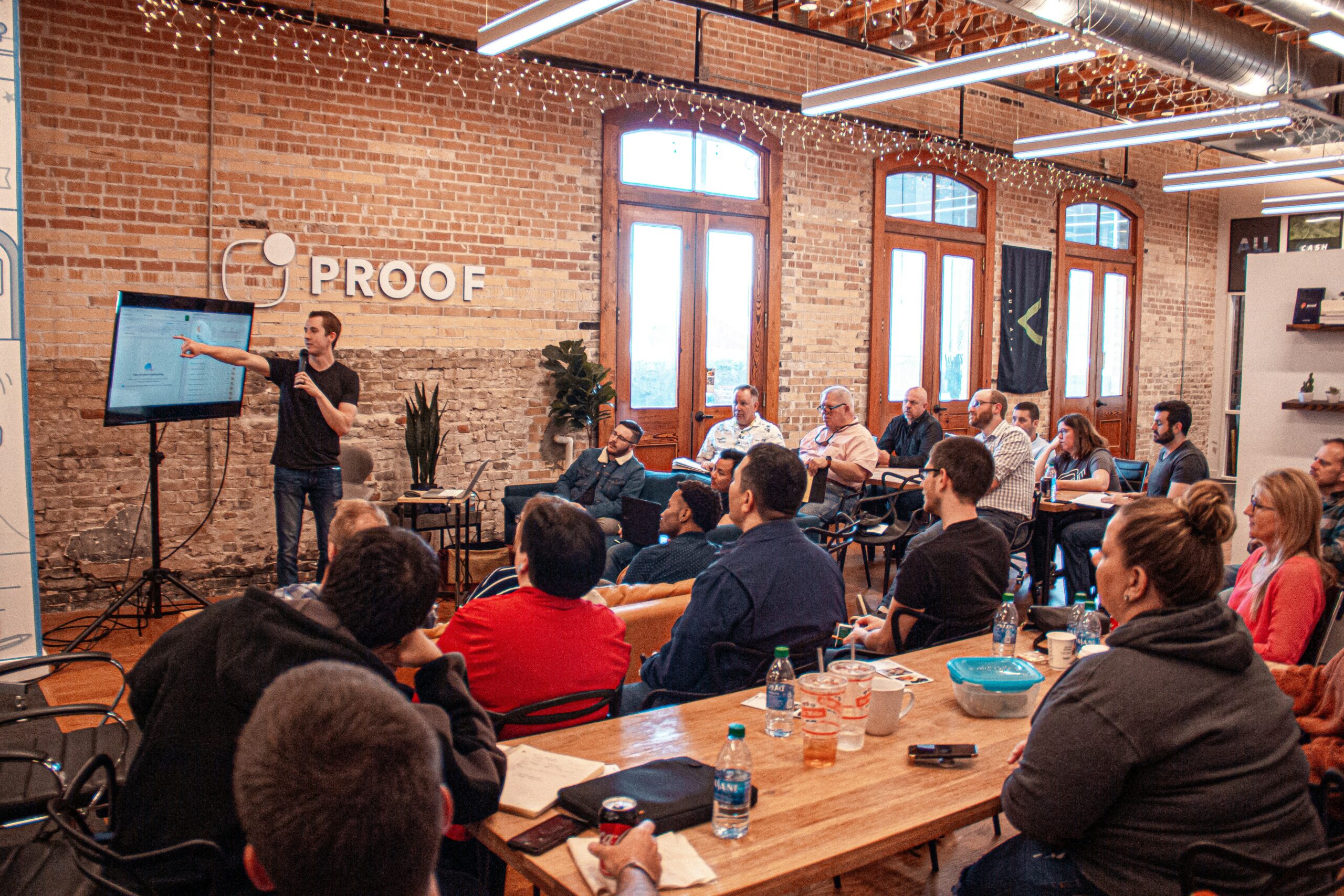

Marketers today are navigating an overwhelming landscape of AI tools and platforms promising to streamline everything from lead generation to content creation.
The modern marketing landscape is practically overflowing with potential technological tools and platforms for businesses to utilize. Because technology has continued to evolve at such an alarming rate over the course of the past several years, many different companies, brands, and entrepreneurs have launched their own apps, sites, and platforms in the hopes of cashing in on the booming industry. However, as the market teeters on the verge of oversaturation, it is becoming increasingly obvious to many business leaders that blindly embracing whatever new tool is available is not the quickest way to success.
Rather, the most successful marketing teams aren’t just adopting more tools; they’re being strategic about which workflows to automate, which platforms to build versus buy, and how to use AI to amplify human expertise rather than replace it.
A Lesson in Simplicity
For Daniel Weinbach, CEO of The Weinbach Group, the first lesson is simplicity. “It is very easy to say yes to an additional subscription for $20 a month or $100 a month because it seems like a nominal investment. And in addition to oftentimes finding yourself wasting money, adding all of those subscriptions and all of that software can often create a degree of chaos,” he says.
He advises marketers to keep their tech stack lean and automate only the functions that matter most before adding another subscription. Beyond this, Weinbach’s agency is also building a bespoke machine-learning tool to replace the outdated press release model. As he details, “It doesn’t take the human interaction out of the equation; it takes that laborious research component out of the equation, and it automates the communication between agency and media in a much more efficient and disciplined manner.”
One of the areas in which both he and the company have been most apprehensive about fully embracing AI is the realm of AI personalization. “Until we have a hundred percent certainty that that level of personalization can be achieved with AI, we can’t rely on it at all because it’s worse to miss the mark than to try and fail. I don’t want to introduce myself to you and say I know you absolutely love covering marketing software,” he explains.
The Benefits of Founder-Led Companies
Cassy Aite, Co-founder of PostBeam.AI, made a bold pivot from ads to content in her career, and wound up finding tremendous success in rebuilding her entire marketing stack around it. “We used to spend over six figures on ads and I always felt like we were renting our growth; I had to pay rent every month in order to keep growing. I always wished I could own our audience,” she says. Now, after spending over $100k per year on ads, she and the team have shifted to owned content, narrowing down to around 30 core topics to attract pre-qualified leads.
Aite has routinely found that the best platforms are built by founders who use them daily. “It’s when you can genuinely tell the people that are building that tool, they actually use it,” she describes. “You can tell love and care has gone into it because they have the same problem. Founder-led companies where the founder is practicing what they preach is what I look for when I’m picking marketing tools.”
Though AI plays a major role in her content workflow, she makes sure to maintain a strong distinction between what is and isn’t automated. “AI-assisted content is amazing. If you use it the right way, it’s really powerful… But at the end of the day, the idea is still mine. It’s AI-assisted, not AI-written.”
Fix the Broken Workflow First
Olga Kokhan, Founder of Tinkogroup, approaches AI adoption with a simple mantra: don’t just add tools; fix the broken workflow first. “My main idea is to keep the system as lean as possible. An AI tool will not fix broken workflows. The search should start not from what tools are available, but what’s taking the most time… Once you understand the process, you can automate it,” she says.
For her team, AI’s biggest impact has been across areas like drafting and repurposing content, automating data aggregation for reporting, and creating simple design assets. As she further explains, “In SEO marketing, you produce content for a blog, then you want to reproduce it for a LinkedIn newsletter or Medium. It’s great usage when you use AI to make a draft of an idea that already exists and then add a human touch.”
However, Kokhan remains adamant that AI is only as good as its inputs. “The data quality is a super high factor in the output of any AI you will take. AI is not magic. If AI doesn’t have proper data, there will be no proper result. It’s one of the main bases of AI,” she concludes.
The Importance of Careful Implementation
Lauren Winder, Director of Content Marketing at Quiq, learned the value of iterative AI adoption the hard way, after a top-down mandate to adopt Jasper fell flat. Now, she has found that taking a more gradual, thoughtful approach is essential. “Being cautiously optimistic to say we’re not going to change everything we’re doing overnight—that approach has worked far better than a top-down mandate.”
Her team has now replaced an analytics tool that surfaced data without direction, choosing AirOps instead for its ability to generate actionable outputs, like fully optimized article drafts and personalized outreach emails. As she explains, “When I found AirOps, I saw this is actually meeting a gap I personally have, which is to take action on the data and the visibility that we’re being shown.”
The results of this approach to AI tools and their careful implementation speak for themselves. “We did the first 10 articles of that cluster, launched them, and all 10 of them are in the top 10 search results on Google. We’re already seeing them being picked up in AI citations across different search engines: Perplexity, ChatGPT, and Gemini.”
The Future is Data Driven
Sirui Hua, Head of Audience and Analytics at NowThis Media, manages content strategy for nearly 100 million social followers. He’s rethinking the entire build-vs-buy decision in the age of AI. “My rule has been: buy the record, because the record is very important and it needs to be reliable. And then the action is something we can build custom-wise. But now agentic AI has flipped that completely,” he says.
He elaborates that, “Even without a tech team, you can actually build some custom workflows and automations yourself without having the technical background. Agentic AI tools like CloudCode can really level the playing field.”
The shift has been driven in part by what he refers to as the “TikTokization of content,” or the accelerating pace of short-form video that demands real-time data analysis. “Now, our whole editorial team is very data-driven. If something is not working, they come to us and ask questions almost immediately. Whenever we get a question, we try to answer it immediately by interacting with our data warehouse through tools like CloudCode. This is definitely a game-changer for us,” he concludes.
Final Thoughts
The common thread across these marketing teams isn’t any single platform; it’s a philosophy. By starting with the workflow and working organically forward from there, rather than starting with the new tool and attempting to force it into an existing system, these teams and leaders have found success. AI works best when it amplifies a well-defined human strategy, not when it’s tasked with creating one from scratch.